
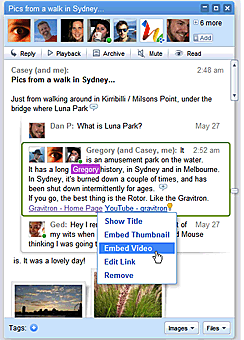
Mid last year Google Wave was unveiled to the world, causing a lot of hype and discussion in Australia for several reasons:
- it was developed by a talented team of Sydney-based Google developers.
- Google Wave was a unique concept that pushed the envelope in terms of web application features.
- it was positioned as the “next best thing since email”.
More than a year on, the dust has settled a little.
I know plenty of people who have tried Google Wave, however none of them use it regularly as part of their day-to-day routine. And it seems that Google agrees, announcing this today on the Official Google Blog:
“…Wave has not seen the user adoption we would have liked. We don’t plan to continue developing Wave as a standalone product, but we will maintain the site at least through the end of the year and extend the technology for use in other Google projects.”
Source: Official Google Blog
It is hard to pinpoint exactly why people haven’t made Google Wave a part of their daily routine, but here’s a few thoughts:
- Google Wave was a developer (invite only) preview for almost 12 months. This meant that it was quite difficult to actually obtain a Google Wave account and begin experimenting with it. And now 3 months after opening it to the public, Google has decided that the product isn’t popular enough.
- Google Wave attempted to push the boundaries of how people fundamentally use the web. People were given the impression that email would be no longer because people would be using Google Wave instead. Humans are creatures of habit. Some of us have been using email since the early 1970′s (not me – I wasn’t even born then!), and it takes time for people to change their habits.
Personally, I thought Google Wave was very interesting, but I struggled to find real life uses for it. I didn’t have very many friends who were using it. Apart from a few initial “this is cool” type conversations, I was happy to continue using email and Skype.
At the end of the day, even if Google Wave has failed, it has done a great job of encouraging innovation on the web – in Google’s own products such as Gmail and Google Docs, and in web applications in general.
What do you think? Did you try Google Wave? Are you still using it today? Why do you think its user adoption hasn’t met Google’s expectations? Feel free to leave a comment below.


I loved google wave. We mainly used it for notes during lectures – but having the entire class chime in on one wave makes a VERY powerful tool. Having every note from every class liveupdated even meant you could study at home if you wanted to and ask your fellow classmates questions as the notes developed – right in the nodes. It’s awesome. I think they’re making a huge mistake by discontinuing this product.
Even though I only finished studying 4 years ago, I hadn’t thought about using Google Wave in an educational/study scenario. Thanks Bech.
Has anyone else been using it for studying and note taking?
Thanks for sharing your thoughts, James.
I disagree; I don’t think Wave has failed – because of the very reasons you mentioned. Although it may not have made the conversions, it’s planted the seed to an alternate way to run your business online. Like you say, people are creatures of habit. It’s going to take much more than three months of public release to convince people to give it a go!
Personally, I found it difficult to use, predominantly because of the lack of access granted. I’m a heavy user of SharePoint so it was more an evaluation rather than something to adopt myself, but I do think more time with the public (along with more practical examples of how it can help you and your business) may have resulted in a more positive outcome.
Thanks Amanda.
You have to wonder whether Google’s announcement has been written in order to try and re-ignite people’s passion for Google Wave.
Threatening to take something away from people is a great way to get people to realise how much they depend on it!
I personally thought that Google Wave was terrific, but like the author, I found that real world use was not what I had expected. The main reason being the lack of adoption amongst the people that I regularly communicate with. Personally, I used it quite a bit to keep myself organized. Using it much like a scratch pad, I was able to have working ideas or projects that were available whenever I logged in, no matter where I was. I had always assumed that once the Wave protocol became more federated, then Wave itself would become more useful/practical. I mean, imagine if they had given up on e-mail after only one year of use because there was only one provider therefore no one adopted it. Things would be quite different these days.
Very true Billy. 3 months of public release is not very long at all!
I think email is one of the foundations of the internet, and even if Google Wave (or another communication protocol) does get popular, email will always be part of our daily routines.
[...] This post was mentioned on Twitter by Glenn Nicholas and Perth Web News, James Collins. James Collins said: Is this the end of Google Wave? http://om4.com.au/is-this-the-end-of-google-wave/ [...]
Huge mistake indeed! But I think they kind of used Wave as a guinea pig, I mean, it hasn’t have the fair time to be adopted, and the feedback Wave has provided as the outcome of the whole math has been considered enough. It’s unfair. Such product would have been given a second (or rather, a first chance, right?) due to its groundbreaking, though simple, innovations. Instead, they preferred to collect the greener profits of a novice technology. As Billy said “imagine if they had given up on e-mail after only one year of use because there was only one provider therefore no one adopted it. Things would be quite different these days”. It won’t take much time for us to see the experience gained with Wave spread over other Google products. A prediction that sounds disrespectful to me, it seems more like a consolation prize which has awkwardly been given.
Sad thing, no doubt.
I think it will be interesting to see how they apply Google Wave features/knowledge/techniques to other Google products.
Thanks for your thoughts Bruno.
I am a comedian and to have the ability to work in real time with my writer and both of us have access from where ever we are is amazing. I also use it in my regular job to keep track of open customer service issues or pending projects, it’s especially good for the kind of project that doesn’t need to be done quickly so everyone can work on it a little at a time and before you know it the project is complete.
Google is making a huge mistake, maybe if they spent a little more time promoting it.
I’m sorry to announce that, but unfortunately , google announced on their official blog that google wave is no longer developed, so sad really, but the bright side is that google said they will include it in chromium OS
It’s great to hear all the different ways that people are using Google Wave.
I also find it strange that Google is yet to announce this on the Google Wave Blog.
The main problem with wave is that not enough people use it. The main use is as a collaboration tool. The main market, therefore, would be for businesses where they come with a built in user base (employees) who are online and waving (is that the term?) at the same time (during regular business hours).
The problem is, with Google hosting Wave, there’s no real tech support and very little data security. I’m surprised to see Google abandon the project so soon after releasing Wave in a Box. I’m glad they will continue working on Wave in a Box, but I would like to see Wave as an open public website that can interface with corporate waves on a corporate server so corporations can use Wave in-house and also use it with outside people without storing the outside waves on their in-house server. That would be useful for, say, contract negotiation.
You introduce it to the public by getting people to use it at work and then watching them use it at home too. Of course it can’t get wide adoption without full e-mail integration, something they never quite nailed down, but I’m surprised to see them abandon something with so much potential.